

Storage cost
The only outputs of the Faraday Reactor are oxygen released into the atmosphere, and our zero-net-carbon kerosene (diesel and jet fuel).
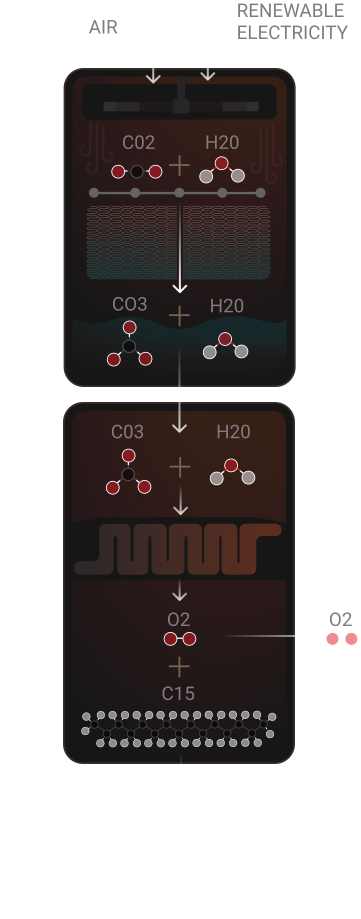
The only outputs of the Faraday Reactor are oxygen released into the atmosphere, and our zero-net-carbon kerosene (diesel and jet fuel).
Reviewed and validated one year of DAC-to-methanol pilot data. Confirmed fully integrated system from direct air capture to finished fuel. Observed kerosene pathway running on a single commercial-scale cell.
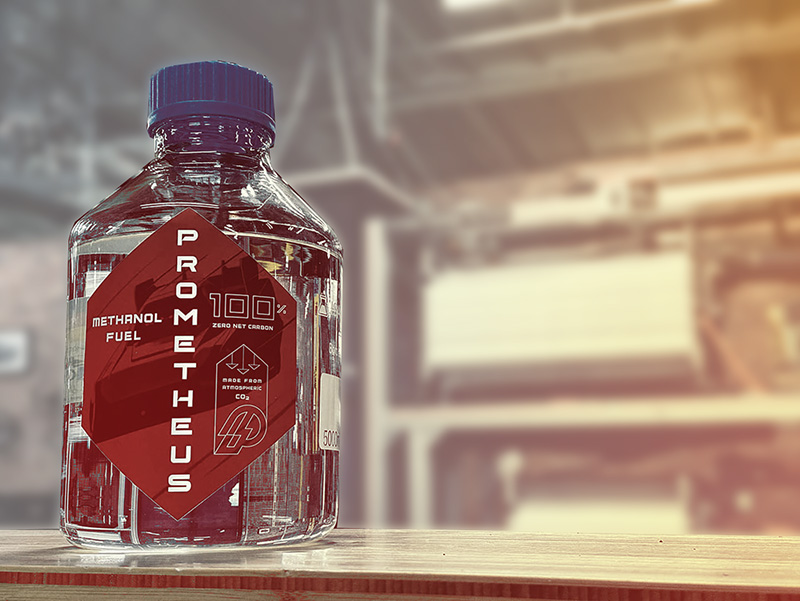
Drew methanol samples sent to external lab — 99.99% purity confirmed. Confirmed direct DC coupling to off-grid solar. No expensive power electronics required.
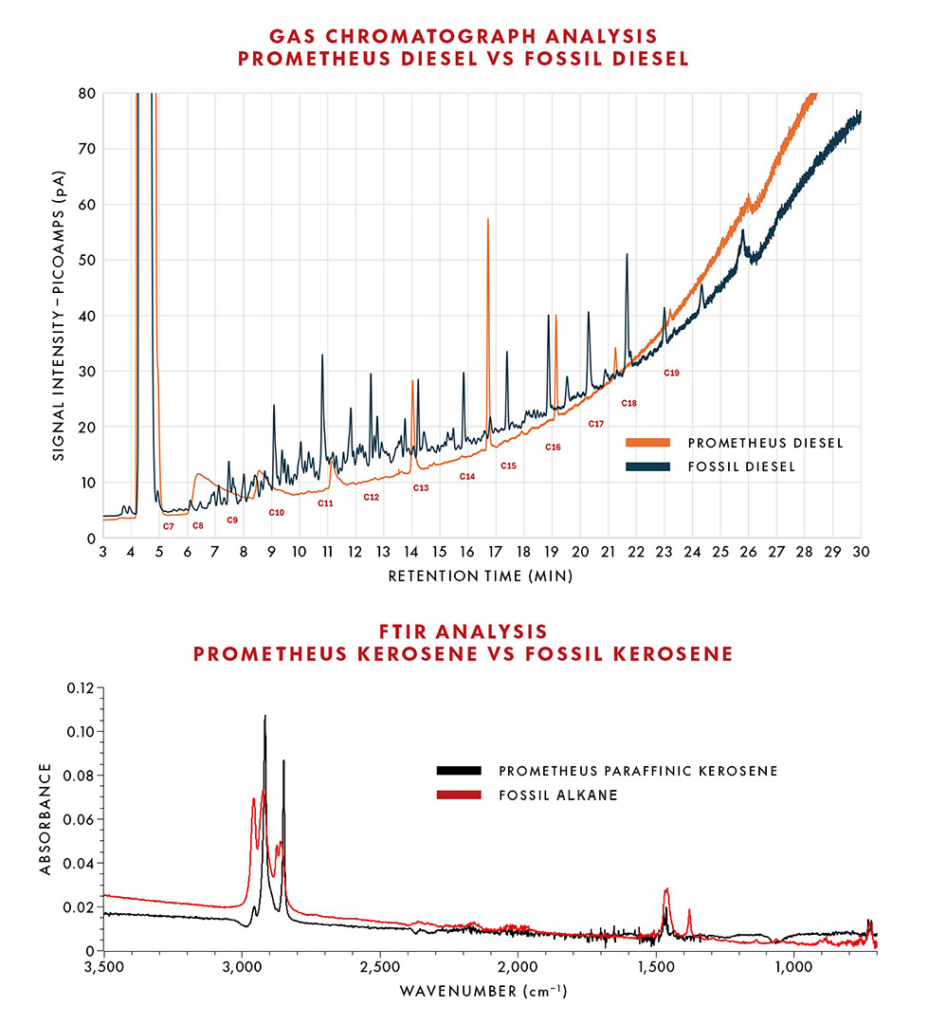
GC graph shows Prometheus diesel hydrocarbon distribution (C8–C19 range) comparable to fossil diesel.
Prometheus paraffinic kerosene FTIR spectrum closely matches fossil alkane reference.
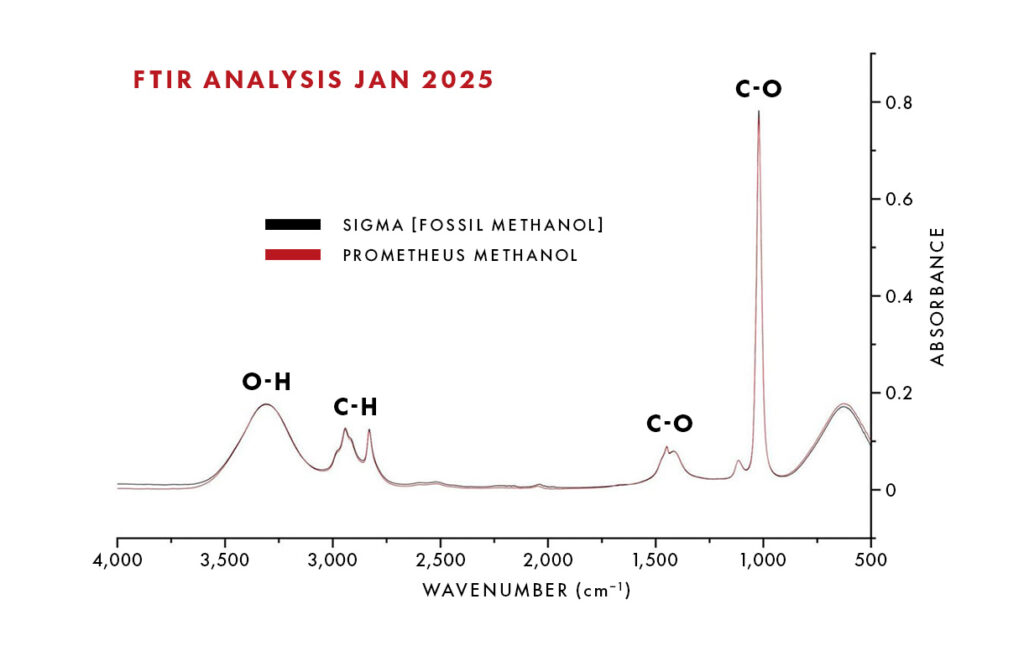
Prometheus methanol FTIR spectrum matches Sigma (fossil methanol) reference — identical O-H, C-H, and C-O absorption peaks.
AmSpec, Houston TX
Prometheus Methanol 10-2-25 (Metal Can) Submitted Sample
IMPCA001II — Methanol Purity (On Dry Base): 99.99 %wt
Carbon Isotope Analysis – Unique Fuel Fingerprint
Prometheus methanol FTIR spectrum matches Sigma (fossil methanol) reference — identical O-H, C-H, and C-O absorption peaks.
FAQs on how direct air capture and e-fuel synthesis actually works
Prometheus uses a new patented integrated Direct Air Capture (DAC) and hydrocarbon electrolyzer system that converts atmospheric CO₂, captured as carbonate and bicarbonate ions in water, directly into finished kerosene fuels (jet and diesel) using off-grid solar electricity.
Unlike conventional approaches, Prometheus jet and diesel fuels do not require the following:
In the Prometheus process, CO₂ is captured from the air into water as carbonate and bicarbonate ions and is not desorbed back to gas. Prometheus kerosene is made directly from the carbonate and bicarbonate using electricity at atmospheric pressure and room temperature. The kerosene self-separates from water inside the hydrocarbon electrolyzer, called a Faraday Reactor, because oil and water naturally separate. The energy that drives the Prometheus process comes from low-cost off-grid solar. These advances radically reduce both capital and energy costs, producing jet and diesel fuels that cost less to make than those made from oil.
Because Prometheus' fuel production process was engineered to remove the major cost drivers of traditional e-fuels:
Prometheus' DAC technology lowers the cost of capturing CO₂ by more than 80% to less than $50/ton CO₂ compared to conventional DAC, because it eliminates the costly, energy-intensive step of desorbing CO₂. Prometheus DAC uses water to capture CO₂ as carbonate / bicarbonate, which is then converted electrochemically into kerosene in a hydrocarbon electrolyzer. The electrolyzer, called a Faraday Reactor hydrocarbon electrolyzer, operates at room temperature and atmospheric pressure, which allows it to be made from inexpensive materials. Lastly, Prometheus purpose-built its process to run off of intermittent renewable electricity. This means Prometheus can power its entire fuel production process using off-grid solar, which enables very low electricity costs. These advances are what allow Prometheus to achieve fuel costs that are lower than fossil fuel commodity prices.
Yes. Every major component of the Prometheus system was designed for low-cost production:
Independent techno-economic assessments (Ramboll, 2021, 2024) validate Prometheus’ commercial pathways and its low costs.
Prometheus captures CO₂ from air as carbonate and bicarbonate ions in water, which are converted electrochemically directly into fuel. This eliminates the most expensive step of conventional DAC systems: desorbing captured CO₂ to a concentrated gas. Because the formation and regeneration of carbonate / bicarbonate ions happen inside the closed loop of Prometheus' novel, integrated DAC-electrolysis system and are driven only by electricity and pH, Prometheus' DAC costs are below $50/ton.
The system was explicitly designed to operate in regions where electricity is cheapest: remote, high-insolation off-grid solar. Because it runs on room-temperature electrochemistry without thermal loads, the Prometheus system can operate directly on intermittent solar and wind at very low cost. Electricity does not need to be baseload or grid-connected. Over 80% of the costs of solar farms today are grid-related costs. Using off-grid low-voltage DC power allows Prometheus to access the lowest cost electricity in the world today, and these costs will continue to drop over time. For electricity cost of $0.05 / kWh or less, a gallon of Prometheus diesel costs less than $5 / gallon.
Prometheus optimizes for the lowest cost of the fuel it produces. While overall electrical energy efficiencies of over 70% are achievable, a lower conversion rate can result in lower overall fuel costs when electricity is inexpensive. At very low electricity pricing, it is best to optimize for cost of equipment (CAPEX cost). In many cases the optimal energy efficiency for the lowest cost fuel is approximately 45-50%.
Prometheus fuels are 100% carbon-neutral, meaning they have a carbon intensity of zero:
The origin of every molecule in Prometheus fuels can be verified using Prometheus' carbon isotope fingerprint method, which shows a unique ratio of ¹²C, ¹³C, and ¹⁴C isotopes that identifies the fuel as being made from atmospheric CO₂ captured by Prometheus DAC.
Prometheus fuels are cheaper to make than oil-based fuels at average pre-war prices for a barrel of oil. As the company acquires “learning by doing” savings with deployment, the cost of its fuels will further decrease. If one considers the OECD countries only and sets the TAM (total addressable market) to 60% of the liquid fuels used by these countries, the TAM is $1.4 Trillion dollars annually. This includes fuels for:
Because Prometheus fuels can be produced anywhere that has access to cheap renewables (e.g., land with good sun), Prometheus systems are globally scalable. The only inputs to Prometheus systems are air and electricity, so there is no limit to their scale of production.
Using the same tech platform and pathway variants, we can make:
Yes, Prometheus' technology and cost models have undergone rigorous independent engineering review, its fuels have been analyzed by external labs, and the strength of its IP position has been verified by its patent counsel at Wilson Sonsini Goodrich and Rosatti.
Prometheus has two commercial-scale projects planned:
Both projects are pre-sold for 10 years. On-site kerosene production systems for data centers, defense, and industrial partners are also in development.
Prometheus has pre-sold 11 million tons of fuel across 10 years totaling over $8B in value at current commodity market prices.
Yes. Prometheus fuels are designed to meet ASTM and OEM requirements. For diesel, Prometheus fuels will meet ASTM D975. For jet fuel, we will apply for a new pathway annex for ASTM D7566. Methanol will meet the IMPCA international standard for purity.
Yes. Prometheus fuels can be used to power data centers by firming and shaping renewables across long time frames of 1500+ hours, storing these renewables as fuels. This includes Prometheus methanol, which can be used in natural gas turbines, and Prometheus diesel, which can be used in aeroderivative turbines and diesel generators already installed in data center backup systems. The Prometheus ultra long duration energy storage (ULDES) systems are closed loop, recovering both carbon and water from fuel use.
Prometheus' technology was created by its founder Rob McGinnis and his team. Several aspects of McGinnis' prior work, as well as contributions from the Prometheus team inspired the development of the tech, including:
Prometheus protected the specifics of its technology while key patents were being filed. The company has always been transparent about what its technology will achieve, but could not fully describe how it works without risks to its IP position. Now that Prometheus’ IP moat has been built to sufficient size and scale, the company can talk more freely about how its integrated no-desorb DAC and hydrocarbon electrolyzer system works.
Virtually all commercial e-fuel systems today rely on Fischer-Tropsch or methanol-to-jet technology to make jet or diesel fuels. These technologies use high temperatures and pressures that make their equipment very expensive. In addition, these processes must run 24/7, meaning they have to use expensive grid power. They cannot compete on price with fuels made from oil at any scale. Only Prometheus has a new technology to make jet and diesel fuels at the low costs needed to compete with oil. Additionally, e-fuel makers other than Prometheus currently use CO₂ from smokestacks (point source) or biogenic sources as their feedstock. These CO₂ sources severely limit where e-fuel makers can site their production. Only Prometheus has DAC that costs less than point-source or biogenic CO₂. And because our CO₂ feedstock is literally everywhere (air), we can site our fuel production anywhere. Our low-cost DAC and hydrocarbon electrolyzer tech stack allows us to make fuel anywhere, any time, at a cost that is less than making fuels from oil.
It is the first 100% electrochemical pathway for producing synthetic paraffinic kerosene directly from the air. This marks the first time in a century that a technology has been invented to make synthetic kerosene-range fuels (e.g., jet fuel and diesel) from atmospheric CO₂ and electricity in a single process step. It is also a breakthrough in cost that makes fuels from solar electricity cheaper to produce than fuels made from oil. In Prometheus' process, CO₂ is captured from the air as carbonate / bicarbonate ions in water. These ions are then converted directly into long-chain hydrocarbons that automatically separate from water at room temperature and atmospheric pressure. This enables:
The physics of "oil and water don't mix" becomes the separation step. The process' simplicity is what enables off-grid operation, ultra-low energy use, and production costs at or below fossil fuel prices. No other company has a pathway like this.
Yes, Prometheus was the first to file patents for direct air capture of CO₂ to carbonate and bicarbonate and their conversion into fuels made from electricity.
In addition, it was first to file on a number of key innovations including DAC and electrochemical pH control methodologies, electrochemical oligomerization, nanotech for fuel separation, the use of novel separators in hydrocarbon electrolyzers, and other critical technologies that establish a robust IP moat for Prometheus. In addition to its patents, Prometheus also has numerous trade secrets accumulated over 7 years of development.
Yes. The Prometheus process is designed to be safe, simple and environmentally-friendly at all scales. It offers the following advantages:
Several key milestones aligned at once:
With its IP protected, its technology validated, and commercial deployment in progress, Prometheus can finally share a fuller picture of how its system works and why it is such a huge leap forward for energy and fuels.