The lowest-cost, fastest-to-deploy energy on Earth is now renewable. Solar electricity has fallen from $0.38/kWh in 2010 to under $0.01/kWh in the world’s sunniest regions.
But renewables come with two stubborn limits: they can’t be stored across seasons at meaningful scale, and they can’t power long-distance transport — aviation, marine shipping, heavy trucking.
As a result, even as renewable generation grows exponentially, fossil fuels still anchor most of the global energy system.
Prometheus closes both gaps with a single breakthrough: a fully integrated direct air capture and hydrocarbon electrolysis system that converts atmospheric CO₂ and off-grid solar electricity directly into finished liquid fuels — methanol, diesel, jet fuel, and gasoline — at a cost competitive with oil.
Our process is unlike any e-fuel pathway that came before it. Conventional approaches rely on Fischer-Tropsch synthesis, methanol-to-jet upgrading, hydrogen production, and high-temperature, high-pressure reactions — every one of which adds cost and complexity.
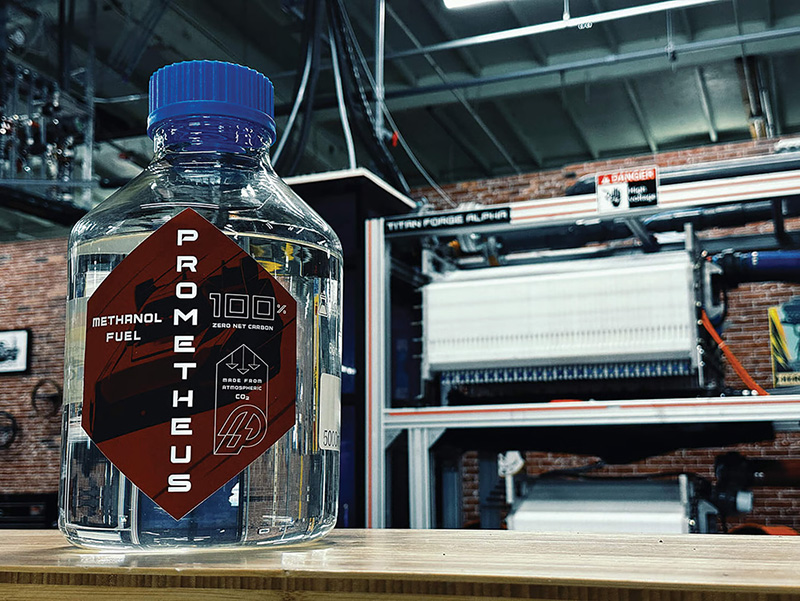
Our patented “no-desorb” DAC captures CO₂ from the air directly into water as carbonate ions, and our Faraday Reactor — the world’s first hydrocarbon electrolyzer — converts those ions into long-chain hydrocarbons at room temperature and atmospheric pressure. The fuel separates from water on its own, the way oil and water always do. The whole system runs on intermittent off-grid solar, accessing the cheapest electrons on Earth.
The result is a process that captures CO₂ for less than $50 per ton, produces 99.99% pure methanol verified by independent lab testing, and yields jet fuel and diesel with low cost at any scale of production.
Prometheus was founded in 2019 by Dr. Rob McGinnis, a Yale-trained engineer whose previous inventions include forward osmosis desalination at Oasys Water, and the world’s first commercial-scale single wall carbon nanotube membrane at Mattershift. Rob is the author of 35+ patents and has taken two prior deep-tech platforms from concept to commercial deployment.
Our team brings together chemical and electrochemical engineers from Tesla, SpaceX heritage programs, NREL, Oak Ridge National Laboratory, and leading materials science companies. Our advisors include former leadership from Chevron Renewable Energy Group, the FAA Office of Environment and Energy, Google X, Maersk, and Los Alamos National Laboratory.
Prometheus exists to make carbon-neutral energy and fuels cheaper than fossil fuels, and to enable renewables to power all our needs.
Our process needs only two inputs — air and sunlight — and there is no upper limit on how much of either is available. We believe the energy transition will be won by innovation and will lower the cost of energy for everyone. We’re building the technology to make this future true.
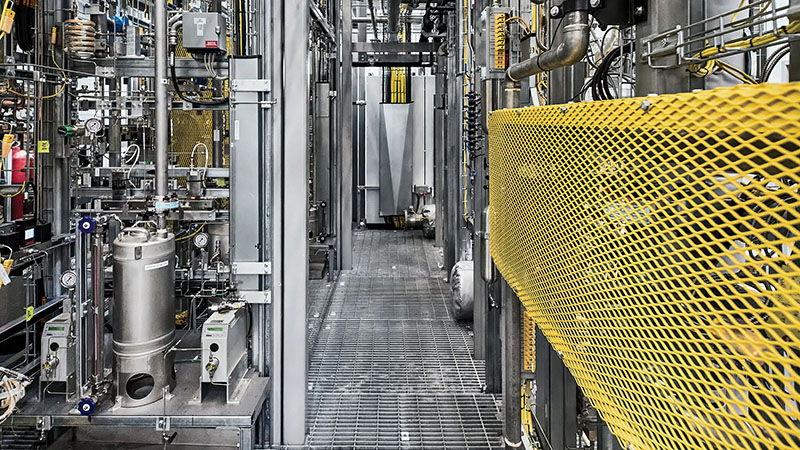
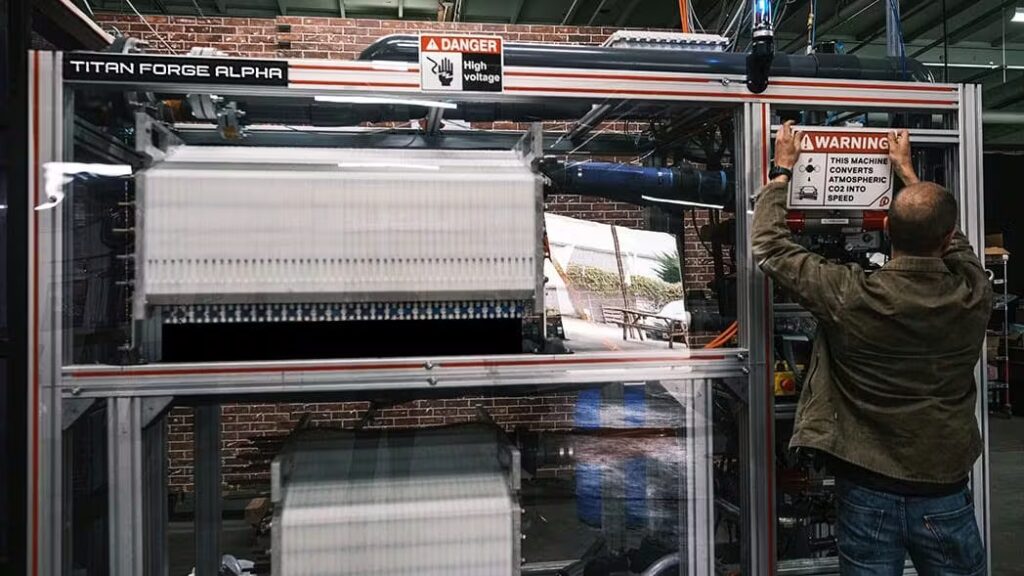

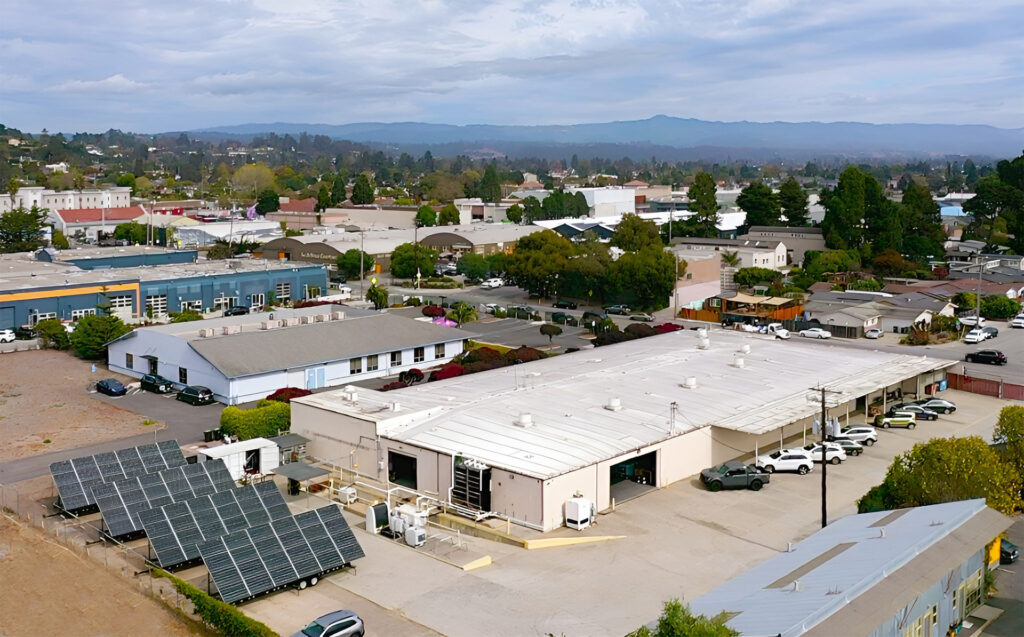
Prometheus Titan Forge Alpha™
Direct Air Capture
Solar
16,000 gallons / year
Explore our timeline of development
The first solar plant to achieve $0.02 per kWh is announced in Mexico, signaling that it is now possible to make e-fuels that can compete on price with fossil fuels
Rob McGinnis files foundational patent for direct air capture (DAC) of CO2 to carbonate / bicarbonate to e-fuels. This patent is prior to any other art in the field
Prometheus is founded by Rob McGinnis and launches out of Y Combinator with Seed funding from prominent tech founder investors
Prometheus demonstrates its first fully integrated prototype system, using its novel DAC to capture CO2 from the air into water as carbonate / bicarbonate ions; converting these ions into ethanol with its first Faraday Reactor hydrocarbon electrolyzer; and extracting the ethanol through a carbon nanotube membrane called the Maxwell Core. This demo, including its prototype machine and fuel, is featured in an article on Prometheus published in the July 2019 issue of Science magazine
The Prometheus DAC process is validated in the academic literature by two independent research groups, showing that CO2 to carbonate / bicarbonate to fuels lowers the cost of DAC by a factor of 10 compared to previous DAC technologies
Prometheus moves into its new HQ, a 20,000 ft² prototyping, manufacturing, and development space
Prometheus closes its Series A round led by BMW i Ventures
Prometheus’ first patent for CO2 DAC to carbonate / bicarbonate to fuels is granted
Prometheus builds its 2.0 demo system with a larger Faraday Reactor (2 m² per cell) and larger DAC
The first solar plant to achieve 1 cent per kWh is announced in the Middle East, further reducing energy cost for price competitive e-fuels
Prometheus demonstrates kerosene range (C8-C19) fuel production from carbonate in a C8 alcohol (octanol) for the first time in its Faraday Reactor hydrocarbon electrolyzer.
Prometheus demonstrates commercial-scale separation of ethanol from water using its Maxwell Core carbon nanotube membranes. Prior to Prometheus’ demonstration, commercial-scale dilute ethanol / water separations had only been achievable using distillation. Distillation is an expensive and energy-intensive process that requires 24/7 power, thus making it unsuitable for off-grid e-fuel production powered by intermittent renewables such as solar and wind.
American Airlines agrees to buy 10 million gallons of Prometheus’ jet fuel
Prometheus engages an independent engineering firm (Ramboll) to do a techno-economic analysis (TEA) and life-cycle assessment (LCA) on Prometheus’ tech platform for DAC to ethanol to gasoline. The firm estimates the cost of Prometheus gasoline at $2.43 / gallon with no subsidies and assesses the carbon intensity (CI) of the fuel at less than 1 gram CO2 per MJ, approaching zero. This represents a >99% reduction in CO2 compared to fossil fuel. The firm estimates the cost of Prometheus’ DAC to be less than $40 / ton of captured CO2.
Prometheus’ Series B round is led by Maersk
Prometheus builds a larger 3rd generation demo system (“D3”). This system includes a DAC with the capacity to capture approximately 12 tons of CO2 per year
Prometheus succeeds in making its first kerosene-range alkane hydrocarbons (octane (C8) and nonane (C9)), pointing the way to the first 100% electrochemical DAC-to-kerosene (jet and diesel fuels) pathway that requires no upgrading or refining. These fuels are co-produced with other fuels including alcohols.
Prometheus shares in a blog post that they overshot their goal to make kerosene (C8–C19 alkane hydrocarbons) and made a solid material with over 30 carbons per molecule, an unprecedented achievement for electrochemical conversion of CO2 to fuels. Prometheus names this fuel product “atmospheric coal”.
Prometheus demonstrates its capability to make RNG (methane) and other hydrocarbon gases from carbonate.
Prometheus engages independent engineering firm (Ramboll) to observe 500 hours of continuous production of C1–C8 alcohols (methanol through octanol) from DAC carbonate on Prometheus’ prototype system using commercial-scale cells, and to do a new TEA for these products. The firm calculates the cost of Prometheus ethanol at $1.88 / gallon (lower than the commodity market price for fossil ethanol). The firm calculates the capital cost of Prometheus’ hydrocarbon electrolyzer stack at $106 / kW (significantly lower than the cost of hydrogen electrolyzer stacks).
Prometheus begins construction of its first pilot plant, Titan Forge Alpha, for production of e-methanol. Methanol’s versatility allows it to replace natural gas in turbines and to power ships; serve as chemical feedstock for a wide variety of products like plastics and adhesives, and as a fuel that can be converted to other fuels like gasoline and jet fuels. Internal cost models estimate that Prometheus’ price to make methanol at commercial scale would be lower than the commodity price of fossil methanol without subsidies.
The Titan Forge Alpha pilot plant is commissioned six months after start of construction. Prometheus begins producing fuel, achieving a methanol purity of 99.9%, meeting chemical feedstock purity requirements
Prometheus shares details of its first commercial methanol project (Project Lodestone) with customers, with a planned capacity of 100,000 tons (33.6 million gallons) per year. Prometheus and its first customer sign the first offtake agreement, selling out Project Lodestone for 10 years, at a value of over $800 million dollars at current commodity market prices
Prometheus demonstrates the first internal combustion vehicle to drive on Prometheus fuel made from direct air capture of CO2 and renewable electricity.
Prometheus shares details of its second commercial methanol project (Project Lodestar) with customers, with a planned capacity of one million tons (336 million gallons) per year, a typical size for commercial methanol plants. Prometheus signs offtake agreements for Project Lodestar, bringing the combined pre-sale value from Project Lodestone and Project Lodestar to over $8 Billion dollars at 2025 commodity market prices.
A full-size (50-cell) commercial-scale Faraday Reactor hydrocarbon electrolyzer stack is installed in the Titan Forge Alpha system to achieve TRL 9 (technology readiness level for a technology that has completed development and is ready for a commercial project)
Prometheus powers off-grid AI with fuel made from air and electricity for the first time in history
Prometheus achieves its goal of developing the world’s first 100% electrochemical pathway for producing synthetic paraffinic kerosene (C8-C19 alkanes, with no alcohols or other oxygenates) directly from carbonate from air and electricity. The achievement marks the first time in a century that a technology has been invented that is capable of making synthetic kerosene-range fuels (e.g., jet fuel and diesel) from atmospheric CO2 and electricity in a single process step. Prometheus’ kerosene pathway will also produce the world’s first jet fuel and diesel that will cost less to make than jet fuel and diesel made from oil. The pathway is moved from the benchtop to a full-size cell in its D3 prototype system, achieving a TRL of 5/6.
Prometheus engages an independent engineering firm (Ramboll) to observe the operation of its Titan Forge Alpha pilot system and verify its performance. During its visit, Ramboll also observes and confirms the production of kerosene made with Prometheus’ revolutionary new 100% electrochemical pathway
An external lab (AmSpec Houston Technical Center) confirms a unique carbon isotope signature for fuels made using Prometheus technology. This signature makes it possible to verify the origin of the CO2 in Prometheus fuels as having been captured from the air using Prometheus DAC technology, at any stage of the supply chain without requiring a chain of custody. A lab test can confirm that the fuel is 100% carbon neutral, made by Prometheus
Prometheus Founder Rob McGinnis is invited by the IEA to attend the G7 Energy summit to inform the G7 energy ministers on the economic and national security implications of Prometheus’ technologies
Titan Forge Alpha reaches one year of operation, demonstrating off-grid solar DAC to e-methanol. Prometheus further demonstrates direct low-voltage DC coupling of solar to its Faraday Reactor hydrocarbon electrolyzer stack, showing that expensive power electronics are unnecessary for the production of its fuels
Maersk engages an independent engineering firm (DeepSense) to observe the operation of its Titan Forge Alpha pilot system and verify its one-year of performance. During its visit, Maersk and DeepSense also observe and confirm the production of kerosene made with Prometheus’ revolutionary new 100% electrochemical pathway
Prometheus Founder Rob McGinnis is invited by the IEA to attend the IEA Ministerial Meeting in Paris. At this meeting Rob announces for the first time a new ultra long duration energy storage (ULDES) capability based on Prometheus tech. The new ULDES system can store over 1500 hours of energy at a capital cost of less than $5 / kWh, 75% less than iron air batteries and 96% lower than Lithium-ion BESS. An example system is described, with 300 MW / 450 GWH specifications, an unprecedented new capability that can enable seasonal firming and shaping of renewables to allow 100% renewable energy throughout the year without fossil backup